
A few months back, I could hand a client a well-researched, well-structured article and feel fairly confident it would rank within a few weeks. That confidence has taken a hit in 2026.
I noticed it first on one of my finance client’s pages. The content was solid accurate numbers, clean structure, decent keyword coverage. But it sat stuck on page two while a competitor’s thinner, less polished article kept showing up in the AI Overview. The difference wasn’t the writing quality. It was that their page had a real author name, a photo, a linked bio with credentials, and a “reviewed by” line. Mine didn’t.
That’s when it clicked for me: writing well used to be the finish line. Now it’s just the entry ticket.
Good Writing Isn't Enough Anymore
E-E-A-T – Experience, Expertise, Authoritativeness, Trustworthiness has been part of Google’s vocabulary since 2014. For years it stayed in the background, something you kept in mind but rarely had to prove explicitly. That’s changed. In 2026, E-E-A-T functions less like a soft guideline and more like a hard ceiling on growth for a lot of websites. You can publish genuinely helpful, well-optimized content and still watch it stall, simply because the page gives search engines and AI systems no way to verify that a real, qualified person stands behind it.
Where It Hurts Most: YMYL Content
This shows up hardest in what Google calls YMYL territory Your Money or Your Life. Health, finance, legal advice, real estate, anything where a wrong answer could cost someone money or safety. If you’ve followed my client list, this covers a good chunk of what I handle daily: real estate brands, gold-loan and finance platforms, renovation services. In these niches, an anonymous byline isn’t a neutral choice anymore. It’s a liability. You can read more about how Google frames this in its own guidance on creating helpful, reliable, people-first content, which is worth bookmarking if you write in any sensitive category.
From "Trust Me" to "Prove It"
The old approach to online credibility was mostly declarative. You’d write “10+ years of experience” in a bio and move on. That doesn’t carry weight anymore not with search algorithms, and increasingly not with readers either, who’ve gotten sharper at spotting AI-generated, faceless content.
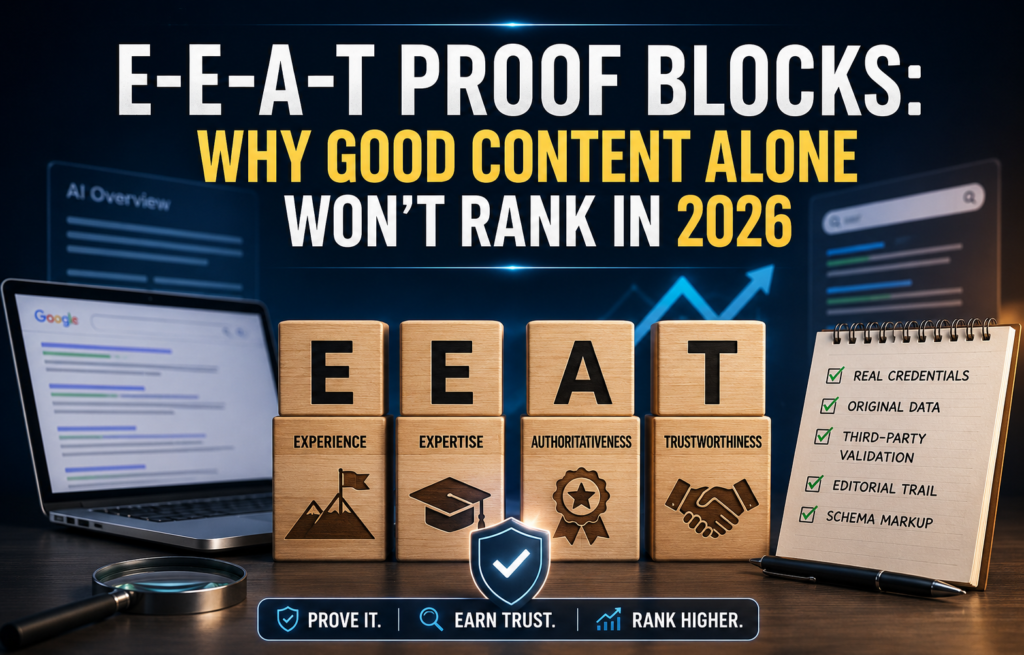
What’s replacing it is what I’d call proof blocks specific, verifiable pieces of evidence built directly into a page, instead of vague claims sitting off to the side.
What a Proof Block Actually Looks Like
- Author bios with checkable credentials. Not “digital marketing expert,” but something specific: “Google Ads Search Certified, currently completing an MBA in Marketing Management, managing SEO for 8 client brands across real estate and finance.” Detailed enough that it can’t be copy-pasted onto anyone else’s site.
- Original data or first-hand results. Before/after screenshots, real case numbers, a Search Console growth graph anything only someone who actually did the work could produce.
- Third-party validation. Guest posts, mentions in industry publications, backlinks from topically relevant sites. Proof that exists outside your own domain is harder to fake than anything you say about yourself.
- A visible editorial trail. Clear “last updated” dates, a named reviewer for technical or financial claims, a correction policy if something changes.
- Person schema markup, connecting your byline to a bio page with properties like knowsAbout, worksFor, and sameAs, so credibility is machine-readable, not just visible to human readers.
The common thread across all five: each one is something an anonymous, AI-generated account genuinely cannot fake convincingly. That’s the entire point of a proof block.
Why This Matters Even More for AI Citation
Here’s where this connects to everything I’ve been writing about AEO and GEO — when an AI engine like Google’s AI Mode, ChatGPT, or Perplexity decides which source to cite in an answer, it’s implicitly vouching for both the content and the author behind it. A named, consistent author with a documented track record is a safer bet for an engine to cite than an anonymous page, because confidence in an answer requires confidence in the source.
Author authority also isn’t a one-time setup. It compounds. Publish consistently within one topic cluster over months and you build a recognizable pattern that search systems learn to associate with a subject. Publish steadily about SEO for a year, then suddenly switch to unrelated topics, and that signal weakens. Depth and consistency in a niche do more for you than breadth ever will.
What I'm Changing on My Own Site, Starting Now
Practically, here’s the shift I’m making across jithugilbert.in and recommending to clients:
- Build a real author bio page not a two-line “About” blurb, but a page with specific experience, certifications, and a verifiable link trail.
- Add Person schema to every post, tying the byline consistently back to that bio page.
- Turn claims into evidence. Instead of saying “I helped a client rank #1,” show the actual keyword, the ranking screenshot, the timeline.
- Stay in one lane. For me, that’s AI Search, AEO, and GEO writing consistently within that cluster rather than scattering across unrelated topics.
- Get validated externally, even in small ways a guest post, a mention, a genuine backlink from a relevant site.
None of this replaces good writing. It means good writing is no longer the whole job. The proof around the content who wrote it, why they’re qualified, and what evidence backs it up has become part of the content itself.
Frequently Asked Questions
Is E-E-A-T an actual Google ranking factor? Not directly. Google has said E-E-A-T is a framework used by human quality raters to evaluate content, not a line item in the ranking algorithm. But the algorithm looks for machine-readable signals that point to the same qualities raters check for, which is why the practical effect on rankings is very real.
Does every website need an author bio page? It matters most for YMYL content — health, finance, legal, and safety-related topics where inaccurate information can cause real harm. For lower-stakes content, it still helps build reader trust, but the ranking impact is smaller.
Can AI-generated content ever satisfy E-E-A-T? Yes, if a real, named human takes editorial responsibility for it, reviews it, and stands behind it publicly. What Google’s systems and AI engines penalize is anonymous, unreviewed, mass-produced content, not the use of AI tools in the writing process itself.
What’s the fastest first step if I’m starting from zero? Add a real name and a linked, specific author bio to your highest-traffic pages first. It’s the single highest-leverage proof block, and it takes a day, not a redesign.
If your site still treats E-E-A-T as an author-bio checkbox rather than a content philosophy, 2026 is the year that gap starts showing up in your traffic.
If you find this useful, I write about AI Search, AEO, GEO, and practical SEO shifts like this one regularly on jithugilbert.in worth a visit if you want to stay ahead of where search is heading in 2026.