
The Psychology Behind Why People Ignore Most Online Ads
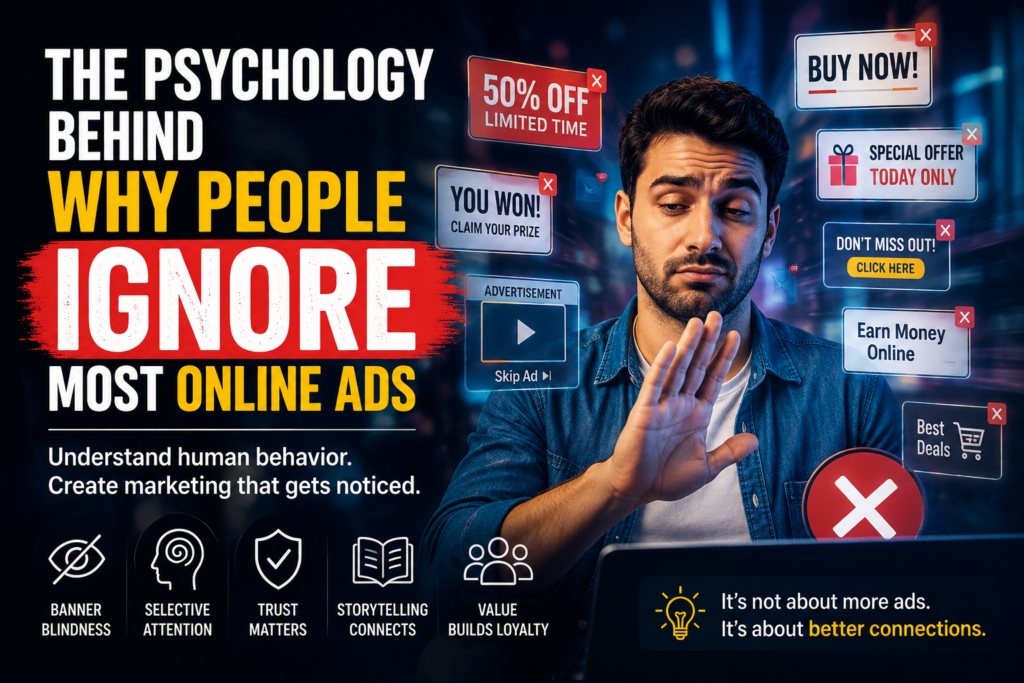
Every day, consumers are exposed to thousands of advertisements across websites, search engines, social media platforms, streaming services, and mobile apps.
Yet despite this constant exposure, most ads are ignored within seconds.
For businesses investing heavily in digital marketing, this raises an important question: Why do people ignore so many online advertisements?
The answer lies not in technology, but in human psychology.
The Rise of Banner Blindness
One of the most common reasons online ads fail is a phenomenon known as “banner blindness.”
Over time, internet users have trained themselves to automatically ignore elements that look like advertisements. Whether it’s a sidebar banner, a pop-up offer, or a promotional display, the brain quickly categorizes these elements as non-essential information.
As a result, many advertisements never receive conscious attention from potential customers.
Consumers Have Become More Selective
Modern consumers are constantly overwhelmed with information.
Emails, notifications, social media updates, videos, and advertisements compete for attention every minute of the day. To cope with this overload, people have become highly selective about the content they engage with.
Rather than responding to every marketing message, consumers focus on content that feels useful, relevant, or personally meaningful.
This shift has made relevance one of the most important factors in successful digital marketing.
Trust Is More Important Than Visibility
Simply being seen is no longer enough.
Many consumers are skeptical of traditional advertising because they understand that businesses are trying to sell something. Before making purchasing decisions, people increasingly seek validation through:
- Customer reviews
- Testimonials
- Recommendations from friends
- Expert opinions
- Independent online research
Brands that establish trust often outperform competitors with larger advertising budgets.
Why Storytelling Works Better Than Direct Selling
People naturally connect with stories.
A promotional message that simply lists features and benefits may be quickly forgotten. However, a story that demonstrates a problem, a solution, and a positive outcome creates an emotional connection.
Successful brands understand that customers rarely buy products alone. They buy experiences, outcomes, and solutions to problems.
This is why storytelling continues to be one of the most effective tools in modern marketing.
Personalization Changes Everything
Consumers respond more positively to messages that feel relevant to their specific needs.
Generic advertising often struggles to generate engagement because it attempts to appeal to everyone. Personalized content, on the other hand, creates a stronger sense of connection.
Today’s most successful marketing campaigns use data, customer insights, and behavioral patterns to deliver more meaningful experiences.
When customers feel understood, they are far more likely to engage.
The Importance of Providing Value First
One of the biggest mistakes businesses make is focusing entirely on selling.
Modern audiences prefer brands that educate, inform, entertain, or solve problems before asking for a purchase.
Content marketing has become increasingly effective because it prioritizes value. Helpful articles, guides, videos, and resources build trust over time and position brands as reliable sources of information.
When value comes first, conversions often follow naturally.
What This Means for Businesses
The future of digital marketing is not about creating more advertisements. It is about creating better experiences.
Businesses that understand consumer psychology can build stronger relationships, improve engagement, and generate more sustainable results.
Instead of asking, “How can we get more people to see our ads?” marketers should ask, “How can we create something people genuinely want to pay attention to?”
That shift in thinking often makes the difference between campaigns that are ignored and campaigns that drive meaningful business growth.
Final Thoughts
As consumer behavior continues to evolve, businesses must move beyond traditional advertising tactics and focus on building trust, relevance, and value.
Understanding the psychology behind attention can help brands create marketing strategies that resonate with modern audiences and deliver long-term results.
For businesses looking to strengthen their digital presence and create more effective marketing strategies, additional insights and resources are available at jithugilbert.in