
Why Your Website Isn't Showing in Google AI Overviews (And How to Fix It in 2026)
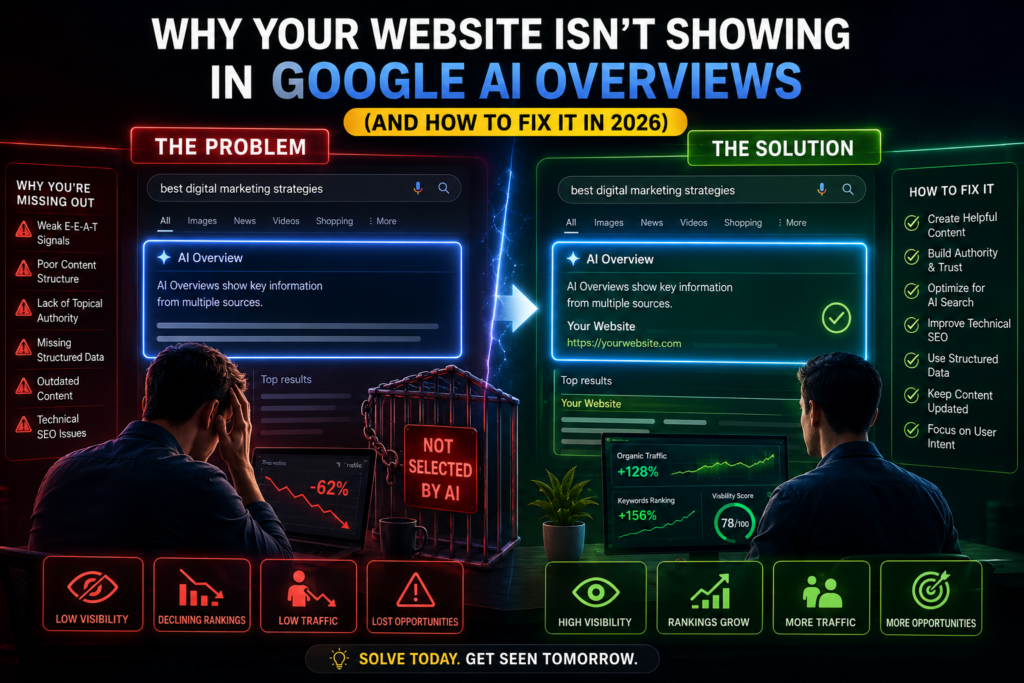
Google Search is evolving rapidly, and AI Overviews have become one of the most significant changes in the search landscape. Instead of displaying only traditional search results, Google now uses artificial intelligence to generate concise answers directly within search results, often citing information from multiple websites.
Many website owners and marketers are asking the same question:
“Why isn’t my website appearing in Google AI Overviews?”
If your content is ranking in search but not being referenced in AI-generated answers, several factors could be limiting your visibility. Understanding these factors is essential for improving your chances of being featured in AI Overviews in 2026.
What Are Google AI Overviews?
Google AI Overviews are AI-generated summaries that appear at the top of search results for many informational queries. These summaries combine information from multiple sources to provide users with quick and accurate answers.
Unlike traditional SEO, where ranking on the first page is often enough to gain visibility, AI Overviews require content that Google considers trustworthy, relevant, and easy for AI systems to understand.
Why Your Website Isn't Showing in AI Overviews
1. Your Content Doesn't Fully Answer User Questions
Google’s AI prioritizes content that provides direct, comprehensive answers to search queries.
If your content is:
- Too promotional
- Lacking depth
- Missing key information
- Not aligned with search intent
it may not be selected for AI-generated summaries.
How to Fix It:
- Answer questions clearly and directly.
- Cover topics comprehensively.
- Include FAQs.
- Use examples and practical insights.
2. Your Content Lacks E-E-A-T Signals
Google continues to emphasize Experience, Expertise, Authoritativeness, and Trustworthiness (E-E-A-T).
Websites with weak authority signals may struggle to appear in AI Overviews even if their content is well-written.
How to Fix It:
- Add author profiles.
- Showcase industry expertise.
- Include credible sources and references.
- Keep content accurate and updated.
3. Poor Content Structure
AI systems prefer content that is organized and easy to interpret.
Large blocks of text without headings can make it difficult for Google’s AI to identify important information.
How to Fix It:
Use:
- Clear H1, H2, and H3 headings
- Bullet points
- Numbered lists
- Short paragraphs
- FAQ sections
A well-structured article improves readability for both users and AI systems.
4. Your Website Lacks Topical Authority
Publishing a single article on a topic is often not enough.
Google increasingly favors websites that demonstrate expertise through multiple interconnected pieces of content.
For example, if you publish articles about:
- SEO
- AI Search
- AEO
- Search Console
- Content Marketing
Google is more likely to view your site as an authority in digital marketing.
How to Fix It:
Create topic clusters and interlink related articles.
5. Technical SEO Issues
Technical problems can prevent Google from properly understanding your content.
Common issues include:
- Slow page speed
- Mobile usability problems
- Broken links
- Crawl errors
- Indexing issues
How to Fix It:
Regularly monitor:
- Google Search Console
- Core Web Vitals
- Mobile usability reports
- Crawl and indexing status
6. Missing Structured Data
Structured data helps search engines understand your content more effectively.
While schema markup does not guarantee AI Overview visibility, it provides additional context that can improve content interpretation.
How to Fix It:
Implement relevant schema such as:
- Article Schema
- FAQ Schema
- Organization Schema
- Breadcrumb Schema
7. Your Content Is Outdated
AI systems generally prioritize fresh and accurate information.
Older articles that haven’t been updated may lose visibility over time.
How to Fix It:
- Update statistics regularly.
- Refresh examples and screenshots.
- Add new industry developments.
- Review content every few months.
8. You're Focusing Only on Keywords
Traditional keyword optimization remains important, but AI search places greater emphasis on context and user intent.
Google’s AI evaluates whether content truly solves the user’s problem.
How to Fix It:
Instead of targeting a single keyword repeatedly:
- Cover related questions.
- Explain concepts thoroughly.
- Address user concerns.
- Provide actionable recommendations.
How to Increase Your Chances of Appearing in AI Overviews
To improve visibility in Google’s AI-powered search experience:
✅ Create comprehensive content
✅ Demonstrate expertise and authority
✅ Use clear content structures
✅ Build topical authority
✅ Improve technical SEO
✅ Add structured data
✅ Update content regularly
✅ Focus on user intent rather than keyword stuffing
The Future of AI Search in 2026
As AI-powered search continues to evolve, website owners must adapt their content strategies. Success will depend less on traditional ranking positions and more on creating content that AI systems trust, understand, and reference.
Businesses should also focus on Answer Engine Optimization (AEO) to improve their chances of appearing in AI-generated responses and answer-focused search experiences. By combining strong SEO practices with AEO strategies, websites can increase their visibility across both traditional and AI-powered search results.
To better understand how AI-driven search is changing the way users discover information, explore our guide on Google AI Mode vs Traditional Search: What Every Website Owner Must Know in 2026.
Businesses that invest in quality content, topical authority, and user-focused optimization will be better positioned to gain visibility in Google AI Overviews and other AI-driven search experiences.
Conclusion
If your website is not appearing in Google AI Overviews, the issue is rarely a single ranking factor. It is usually a combination of content quality, authority, technical performance, and overall relevance.
By creating helpful content, improving E-E-A-T signals, building topical authority, and maintaining strong technical SEO practices, you can significantly improve your chances of being featured in AI-generated search results in 2026.
While there is no guaranteed way to appear in Google AI Overviews, following Google’s recommended search optimization practices can improve your visibility over time. For official guidance on SEO and search best practices, visit the Google Search Central Documentation.